Watch video of integral living in Ewu Monastery, Edo state of Nigeria. This video captures some of the tenets of Communitalism.
[embedyt] https://www.youtube.com/watch?v=AtZ_xoBJifM[/embedyt]
Ewu Development and Educational Multipurpose Co-operative Society

Watch video of integral living in Ewu Monastery, Edo state of Nigeria. This video captures some of the tenets of Communitalism.
[embedyt] https://www.youtube.com/watch?v=AtZ_xoBJifM[/embedyt]
![The Pioneer Students Transformation Studies in Africa [Video]](https://www.paxafricana.org/wp-content/uploads/2019/11/piooneer-students-transformation-studies-in-africa-paxafricana-1.png)
[fullscreenvideo videourl=”https://youtu.be/tGFp-4BmBJc”]
Watch video of the pioneer students of Transformation Studies in Africa (TSA) from the Institute of African Studies, University of Ibadan, Nigeria. This is the first fruit of a project with a very humble beginning

The Pax herbal Clinic and Research Laboratories (PAXHERBALS) and its subsidiary, the Pax Integral Research and Development Initiative (OFIRDI) have signed an MOU with the Catholic Bishops Conference of England and Wales, to provide training in sustainable agribusiness for the young people of Edo State, Nigeria. The project is termed human livelihoods for self-sufficiency.
The objective of the human livelihoods project is to provide young people in Edo State and Nigeria with training and employment, both directly and indirectly, as an alternative to the risks of being trafficked into modern slavery and exploitation, injury, death and crime, which very many faces if they travel in reliance on the promises of ‘well-paid work’ abroad.
The human livelihoods project differs from the ‘help the poor’ approach that tends to make people perpetually dependent. The project is based on a model of development that gives a once-off help, to enable the trainee to become self-sufficient and independent.
The strategy is as follows:

On May 10, 2018, the newly designed curriculum titled Transformation Studies in Africa started on a high tone with 12 pioneer masters students and one prospective PhD candidate, at the Institute of African Studies, University of Ibadan. The program, which is a partnership between Ofure (Pax) Centre for integral research and Development, The University of Ibadan and Trans4m Centre for Integral Development, is the first of its kind in Africa.
During a prolonged academic interaction with the faculty staff, Fr. Anselm Adodo, explained that Transformation studies are an evolution of African studies, which grew under the tutelage of colonial scholarship. African studies originated from Europe and were designed as Western scholars studying African people and culture from the western point of view. Most often, such studies were coloured by the prejudices and biases of the foreigners. With transformation studies, Africans can study Africa with African eyes and in their own language and metaphors.
Transformation Studies in Africa, code-named TSA, aims to ‘release the GENE-IUS’ of Africa. It aims to study African issues, African realities, African problems from the African point of view, and provide African solutions to African problems. TSA, according to Adodo, is Africa writing her history based on her own experience, in line with the African proverb, ‘until the Lion learns to write, every story will glorify the hunter’.
Director of the Institute of African Studies, Dr Ohioma Pogoson, expressed his delight at the successful take-off of the program. The number of the successful candidates, according to him, is a good indication that TSA might well turn out to be the most successful and crowd-pulling program offered at the institute. The immediate past director of the Institute, Prof. Dele Layiwola, observed that it is unusual for a brand-new program as TSA to have such a high number of candidates. He also announced that the program would begin admission of PhD students in 2019, another milestone for such a new program. In fact, a PhD candidate has already applied and has opted to wait patiently till 2019 to join the program rather than
enrol for another course.
Fr. Adodo thanked all those who were involved in the curriculum development process and planning stages: Prof. Layiwola who was then the director of the Institute, Dr. Femi Jegede, who worked tirelessly to ensure that the program passed through the various screening stages at the University of Ibadan, and Dr. Pogoson who gave his support to the program as the new director. He also thanked Professors Lessem and Schieffer of Trans4m centre for Integral Development for their interest in Africa. Both Lessem and Schieffer were actively involved in the development of the curriculum and even visited, along with Fr. Anselm Adodo, the Vice Chancellor of the University in 2016.
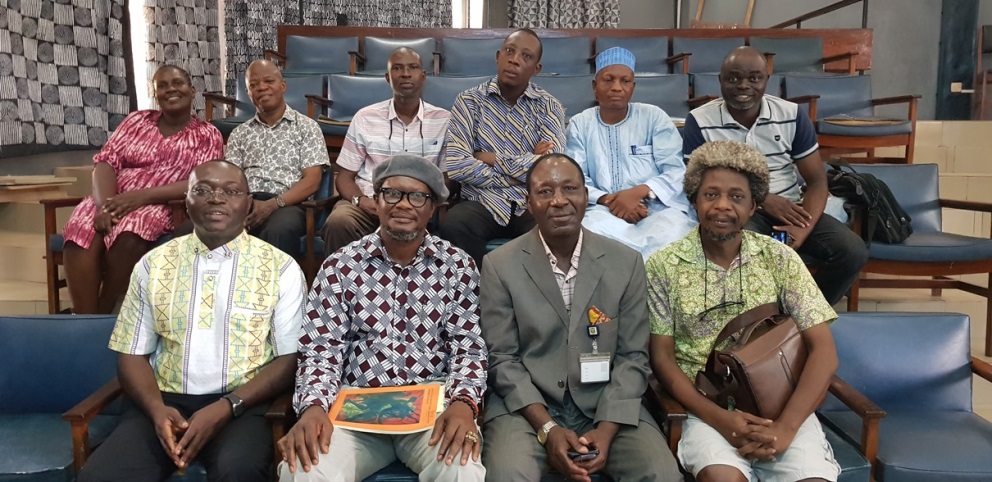
During interaction with the students, Fr. Adodo congratulated the new postgraduate students and
informed them that joining the TSA program might well be one of the most significant decisions of their lives. TSA, according to him, is radically different from other courses at the university, as it is reform-oriented, and aims to encourage students to think and act differently. The students expressed their delight at being selected to join the program. They said they entered the program because they want to become agents of Transformation in their communities, society, the country and the world and that the term, ‘Transformation’, struck a chord in their hearts. As a further sign of interest and attention which the program has generated, Fr. Adodo has been invited by the Institute to present a paper on African
Transformation at the prestigious Faculty seminar of the University in July 2018.
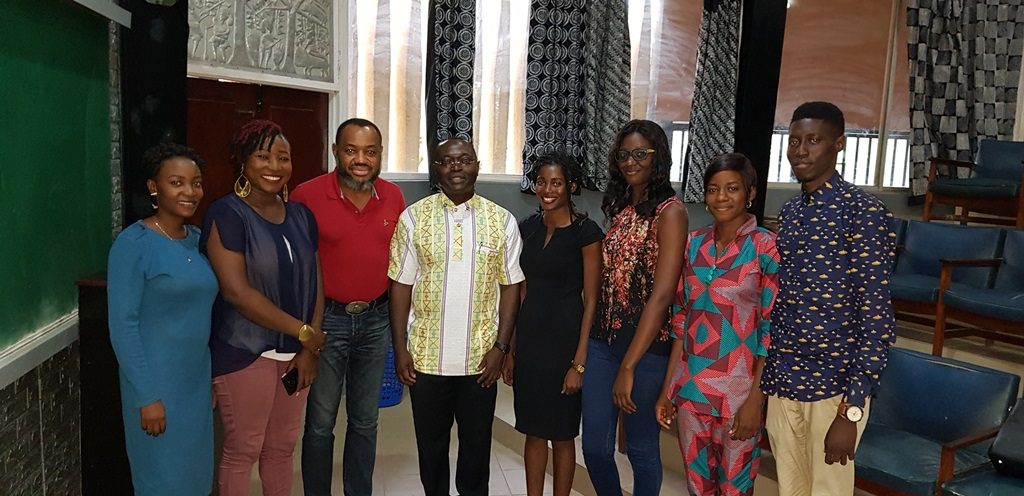

In April this year, we had a meeting with the local farmers, about sixty of them. It was part of our participatory action research strategy, getting the people to identify, discuss and analyse their challenges and then proffer solutions from within. The local people complained that cassava farming is no longer profitable. Many families cultivate cassava, which they harvest, eat and then sell the leftovers. This is subsistence farming. They spend so much time and energy in the sun clearing the bush, planting and then waiting for the cassava to grow and mature. At the end of the day, they are able to harvest a few bags of cassava, which is priced very cheaply in the local market. To give a higher yield of cassava, the government shares thousands of fertilisers that they claim help to improve soil yield. But the people know the fertilisers don’t provide the solution, and only deplete the soil. They know organic farming is best.
At this meeting, the group agreed to invite the most elderly women in the communities to the next meeting. These grandmothers and great-grandmothers are custodians of knowledge in the local communities. The oldest among them was an energetic slim old mama, who is 120 years old, while the others were between the ages of 75 to 110. As a student I had read in the books that life expectancy in Africa is low, 40% in some countries, 55% in others. The main reason, of course, was said to be poverty, meaning, in this case, a lack of money. The reality is there are many septuagenarians, octogenarians, nonagenarians and centenarians, many of them still active and alert. This misunderstanding of life expectancy is one tragedy of research and the researched. The researcher tells the story from his or her own point of view to suit a certain stereotype.
‘Once upon a time’, the eldest woman in the community, Mama Ageless, as she is fondly called, said, ‘there were mushrooms growing all over the land, and we used to harvest them to cook. These mushrooms supplied us most of our nutrients. But these days, there are not more mushrooms. Rather, we have bread and fries. Bring back mushrooms to the village’.
In the next meeting, the group of farmers decided to explore oyster mushroom farming. But all believed that mushrooms only grow in the wild, and no one knew they could be cultivated. As the chief co-researcher, I reached out to my colleagues to inquire about mushroom farming. The way forward is always to blend local indigenous knowledge with exogenous knowledge. The theory of “communitalism” , which I developed in my new book, ‘Integral Community Enterprise in Africa’, is based on the need to forge a synergy between these different modes of knowledge creation, bridging the gap between the old and the new. This is what I refer to as a communiversity rather than a university, a calabash of wisdom where knowledge flows in and out in the community, and into which everybody has something to contribute.
Within two months, I organised a training session on mushroom cultivation to a select group of the local farmers. The two species cultivated were Pleurotus Ostreatus and Pleurotus Pulmonarius. Many of the selected people did not attend because they did not believe that mushrooms can be cultivated. Those who attended were enthralled, surprised and excited. It was a eureka moment for the participants, and they all exclaimed, ‘So it is possible!’
Since the initial training, hundreds of local farmers have applied to join in the next training. The goal is to move from subsistence farming to secure livelihoods, from food sufficiency to food security, from agriculture to agribusiness. Whereas a 100-foot plot of land can only give a few cassavas worth N35,000, the same plot of land could produce bags of mushrooms worth N150,0000. Unlike cassava cultivation, mushroom is planted inside the house rather than in the open, and the waste from the mushroom soil is far more useful as fertilisers than the synthetic fertilisers provided by the government.
I have attended many seminars and workshops where I was taught that people need money in order to eat a balanced diet, and that if you give poor people money, they will eat good food. Armed with such foreign-made academic knowledge, I went to work among the poor men and women in a rural community in Nigeria. And they taught me another set of lessons, more realistic and more down-to earth. Here are some of the lessons:
The acquisition of Western knowledge has been and is still invaluable to all, but, on its own, it has been incapable of responding adequately in the face of massive and intensifying disparities, uncontrolled exploitation of pharmacological and other genetic resources and rapid depletion of the earth’s natural resources. In that context, a return to indigenous knowledge, cast in contemporary guise, is all-important.
In a divided world as ours, we do not need more billionaires, more consumers and more powerful men. The world is in dire need of more healers, more peacemakers and more storytellers, and this is where the true researcher comes in.
Recently, some members of EDEMCS executives: Anna Aipokhio, Yinka Olayioye and Photographer Austin Obi visited the beneficiaries of the first phase of the business loan project of EDEMCS for an impact assessment on the farmers. The loan was given in January 2016
The loan was given in January 2016 to empower the local women. The principles of participatory action research, which form the basis on which EDEMCS was founded, requires that any help given to the rural community should empower them towards sustainability and independence, rather than make them become perennially dependent on Aid. For ACIRD, we believe that aid should make people more independent and innovative, and inspire them to be creative entrepreneurs. In this report, we let the beneficiaries speak for themselves.
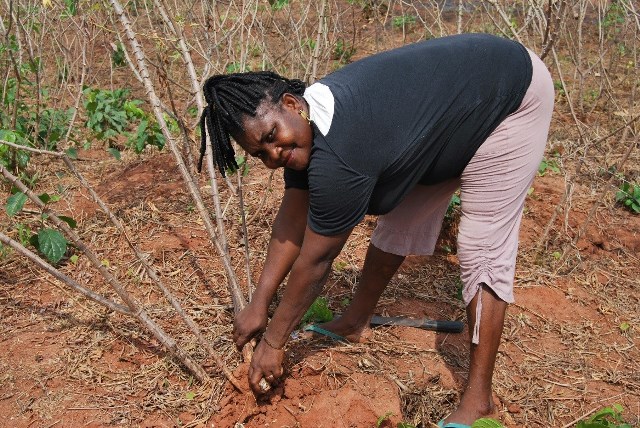
MRS IDIATA STELLA, is a 49 years old widow with five children. She is from Ehanlen community in Ewu kingdom.
Question: What is your opinion of the loan support scheme?
Stella: I thank EDEMCS for their loan support scheme. It is a very laudable project and I am happy to be among the first beneficiaries.
Question: How and why were you selected as a beneficiary?
Stella: I was nominated by the village elders based on their assessment of me as a serous-minded member of the community. They are aware of my challenges and struggles. They asked me to obtain the application form from EDEMCS, which I did.
Question: What kind of business do you do?
Stella: I am into livestock rearing and crop farming. I have been in this business for about five years now. I am into this kind of business because I love taking care of animals. Taking care of animals gives me the opportunity to monitor my farm.
Question: How has the loan benefited your business?
Stella: The loan given to me has helped to increase the number of goats from 8 to 25, and I was also able to increase the size of my tomato and cassava farm. Although the money was not enough but I was able to expand my farm and livestock.
Question: Would you like to apply for more loan?
Stella: I wish I can have more, I will willingly take if given. My advice to other women is that EDEMCS has come to help the community and the loan is very convenient to pay, especially as there is no interest.
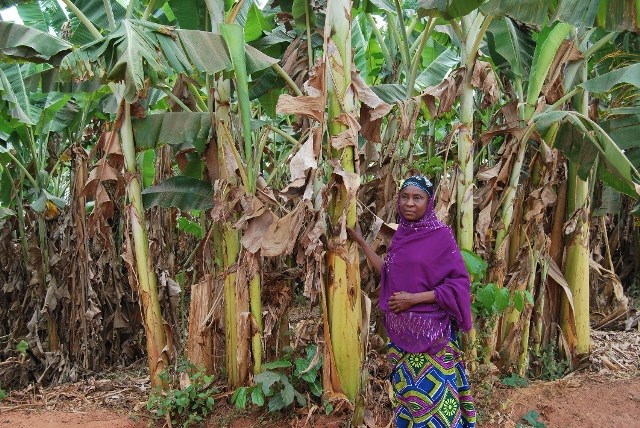
MRS. DAUDU ZUMA NUSA is from Eguare community in Ewu kingdom. She is a 60 years old Muslim married with five children.
Question: What is your opinion of the loan support scheme?
Daudu: I came across EDEMCS during its inauguration. I was selected by my village as one of the beneficiaries. I obtained the loan application form from the village representative, because the process of the loan system is convenient and the source of the funds is genuine.
Question: What kind of business do you do?
Daudu: I am into farming. I cultivate plantain and cassava. I am also into trading and the rearing of animals (sheep and goats). I used the loan to hire labourers for the farm, thereby increasing the portion of land I cultivate.
Question: How has the loan benefited your business?
Daudu: I am very happy because the loan helped me to expand my farm land from what I used to cultivate before and also expanded my business in agricultural produce.
Question: What is your advice for other women?
Daudu: My advice to other women is that the loan is very convenient and the payment conditions are very favourable. They should use the money for the purpose for which it is meant because in the village, integrity is also a capital.

REGINA AIKHUELE, 52, is from Idunwele community of Ewu. She is married with six children.
Question: What kind of business do you do?
Regina: I have been a poultry farmer for 25 years. It’s the kind of business I love doing.
Question: How has the loan benefited your business?
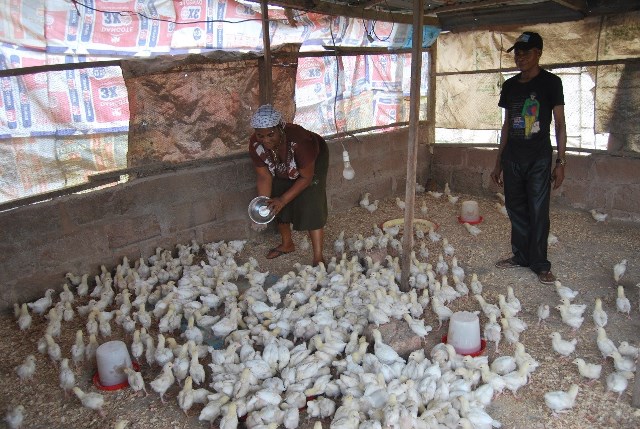
Regina: I am proud of EDEMCS. I was selected by my village as one of the beneficiaries. EDEMCS is genuine and because of their background, I believed in them. Through the loan given to me I have been able to expand my poultry business. As you can see, these are new set of chickens I have just bought and they are doing very well and there is great improvement in my business. I sold that last set of birds during the Christmas period. The only challenges am having now is that the cost of buying their feed has skyrocketed.
Question: Would you like to apply for more loan?
Regina: If another opportunity is given to me I willingly accept.
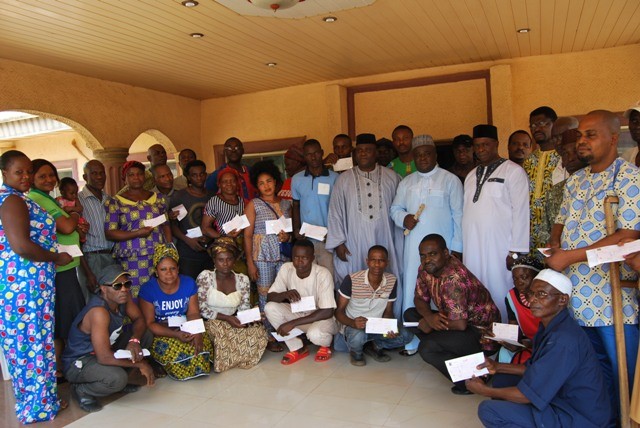
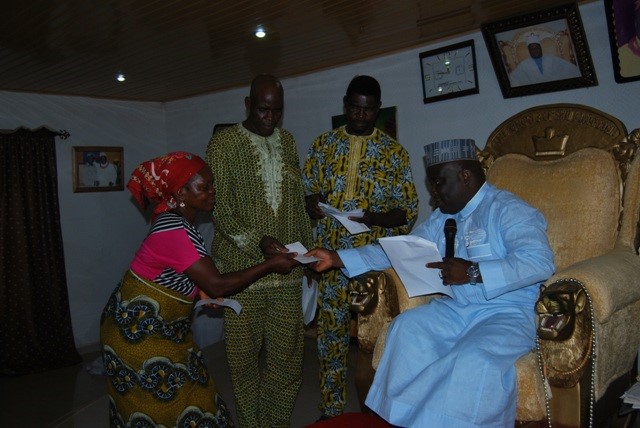
In February 2016, a group of local women farmers was presented with a cheque of $500 each to support them as they prepare for a new farming season. The money was presented to each farmer as a loan, which will be paid back within 12 months with zero interest. This is a development project initiated by the local communities themselves.
The oldest man in her community called the Ukodion, and the king of Ewu, guaranteed each beneficiary. No other collateral is needed except the integrity of each beneficiary. With this option, we adopted a parallel that is unlike the conventional top-bottom, western system of bank-controlled loan giving

In December 2016, another group of twenty men, women and youths were presented with a cheque of $500 each. They are all local entrepreneurs with a passion to earning a decent living in a sustainable way while also benefiting the community. They were selected from the different communities in Ewu kingdom. Each loan attracts a mere 2% interest.
The loan for EDEMCS was made available through a triangular partnership between ACIRD, based in the rural community of Ewu, Edo State, and Sterling Bank, through a special project aimed at empowering local communities and CISER, a Centre for Integral Socio-Economic Research, based in Lagos, Nigeria’s commercial capital.
The Ewu Development and Educational Multipurpose Cooperative Society (EDEMCS) is an initiative of Ofure (Pax) Integral Research and Development Initiative (OFIRDI), a subsidiary of Nigeria’s foremost herbal research institute, the Pax Herbal Clinic and Research laboratories (PAXHERBALS). ACIRD, nicknamed Pax Africana, is an evolution of Paxherbals from an organization, which deals mainly with traditional medicine as an alternative and complementary practice to allopathic medicine, to Pax Africana, a Centre that explores healing beyond biological or physical health to integral healing.
CISER is made up of a group of young Nigerian bankers who are passionate about evolving a new model of development banking and entrepreneurship built on local culture, worldview and community. Such a model will be well suited to the African context and tradition, rather than merely imitating the western model, using the Ewu community development association, EDEMCS, as a test case. Co-founder of CISER, Basheer Oshodi, believes that the principles of Islamic banking and finance can be adapted to bring about authentic socio-economic development in Africa.
Through a combination of Participatory Action Research (PAR) and Co–operative Inquiry (CI) research methodologies, a group of researchers at ACRID, led by Fr. Anselm Adodo, employed the tenets of PAR to activate the local community of Edo State to engage in regular dialogue to identify their challenges, and find a common ground to effectively proffer their own solutions rather than solutions from without. This led to the creation of Ewu Development and Educational Multipurpose Cooperative Society (EDEMCS). From a local group of marginalized and underrated people, EDEMCS is becoming a voice powerful enough to challenge the status quo, and ‘force’ a change in power relations in Edo state and Nigeria.
ACIRD aims to institutionalize knowledge creation in and for Ewu village in Edo State, Nigeria and Africa as a whole via a new theory called Communitalism, based on the four aspects of Pax: Pax Communis, Pax Spiritus, Pax Scientia and Pax Economia, altogether called Pax Africa. Communitalism, originating from the South, demonstrates that an institutionalized model of business and enterprise based on nature, community, spirituality and humanism, integrally so to speak, is a better driver of social and technological innovation in Africa.
Rather than ‘doing a project’ for the people, Pax Africana resolved to animate the local community by encouraging the different communities to engage in regular dialogue to identify their challenges and find a common ground to effectively proffer their own solutions rather than solutions from without.
The distinguishing feature of EDEMCS is that the local community is building on their own traditional systems, structure and worldview in order to create a better world for themselves. This bottom-up approach is a key element of sustainable development. The association cuts across all the villages that make up the Ewu kingdom. EDEMCS aims to identify the key potentials and resources in the local communities so as to develop them in a systematic and strategic way to lead to self-sufficiency, wealth creation and general transformation of the whole community, Edo State and Nigeria at large. The key concepts of EDEMCS are innovation and creativity and the belief that development and wealth can be attained and sustained only when they are grounded in local culture and worldview while open to modern changes.
EDEMCS’ sphere of influence covers all aspects of the life of the people: agriculture, small business enterprises, skill acquisition, teaching, youth empowerment and business management. Whatever brings development and progress to the community is of special interest to the association. The motto of EDEMCS is ‘United we stand. Divided we fall’
EDEMCS members also comprise many active local women, who are the driving force behind the association. Among them is Esther Otoide, a traditional taxonomist, who is renowned for her ability to identify different species of local herbs and their historical use.
It is alarming that the local communities in Ewu and all over Nigeria are fast losing knowledge of the local names of medicinal plants as the old men and women have died, while the young people are heading for the cities. Esther works with other women to collaborate with Paxherbal in documenting the local names of medicinal plants and flora in Ewu and Edo State.
Through monthly meetings, the farmers are gaining new insights into traditional farming techniques and its often hidden potentials.
Within EDEMCS are three active subgroups.

Recently, EDEMCS attained the knowledge that there is an abandoned library in Eguare, one of the communities in Ewu. On the invitation of the local community managers, EDEMCS representatives went to inspect it, and we came to the conclusion that there is the potential of rebuilding and revitalizing the said library. We believe that a local library is a necessity for a community to provide the means for education in order to encourage a reading culture amongst the community.
For many years, an ever-increasing number of young people have been leaving the Ewu community for academic pursuit elsewhere. Families too are leaving and moving to places like cities where they could get better education opportunities for their families. This leaves a lot of the poor families that can’t afford to leave the community behind. Since poorer families have no place like a library or community center for learning for their children after school hours, the children are frequently made to become child workers. The result is very poorly educated young boys and girls who frequently fail to qualify for university (college) eduction.
For this reason, EDEMCS has taken up the challenge of calling for needed help in building a modern library with full-featured learning materials which will include books, computers, and internet access. We seek support for this project from readers and organizations that will be able to help. Donations for a new building, books, computers, and modern learnings tools will be needed in order to provide a better learning environment for the community.
Do contact us if you or any organization you know will be willing to help us provide a better learning environment for children in this community. We want to look back in 10yrs and be able to have engineers, doctors, and other professional created because of your support for this venture.
Written by Amadeus Stickl and edited by Ojo Anthony

The seasons are changing, the rainy season is here and nature is preparing to sprout and to blossom. The first days of March coincided with the first days of rainfall. Famers are busy with preparations of their farmlands for cultivation.
Several weeks have passed since EDEMCS (Ewu Development and Educational Multipurpose Cooperative Society) gave out microfinance loans to the local farmers in the Ewu Community. Collectively we thought that it might be time to visit the women, to see the progress they have made and to hear their stories. Hence, a group of EDEMCS representatives set out to see these seven farmers in their homes and on their farms. Listening to the people is one of the key features of Participatory Action Research, based on the integral research model that forms the theoretical framework of EDEMCS community development approach.
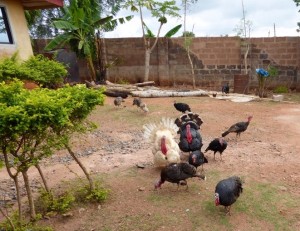
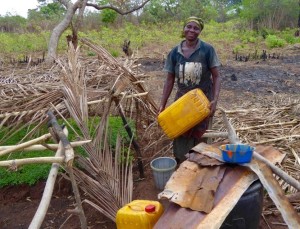
Upon arrival the EDEMCS reps were welcomed in a very hospitable fashion, the women were excited to see and talk to them.
The majority of the farmers are planting cassava, yam, tomatoes and peppers. It is now a very intensive time for them. The money from the first grant was mainly used to clear the fields. Since this is done by hand and not with automated machinery, it is a time-consuming and expensive task. This means bigger farmland for planting can be prepared.
Upon questioning if they would apply for a loan again all of them said yes, however, they proposed to increase the amount of money. This proposal will be taking into consideration for the next round of financing but is also dependent on how the end result will look.
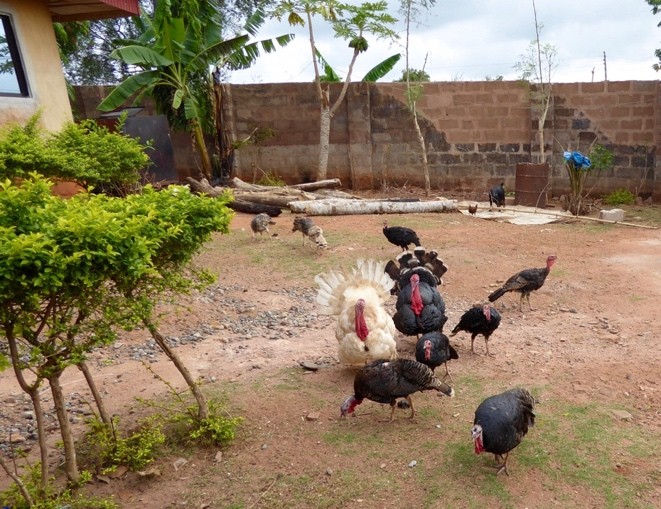
Some of the women are cultivating poultry – turkey and chicken to be specific. They buy chicks, raise them until they are matured, and then sell them on the market. With the loans, they increased the number of chicks and it remains to be seen if this will be something they can sustain and hence profit from it in the long run.
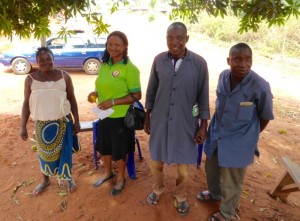

The overall experience of seeing the farmers and how excited they are about this development effort was very positive.
Of course, we are only in our starting phase and not everything is perfect yet, but a solid start has been made and hopefully we will further develop in the future in order to be a sustainable initiative.
Written by Amadeus Stickl
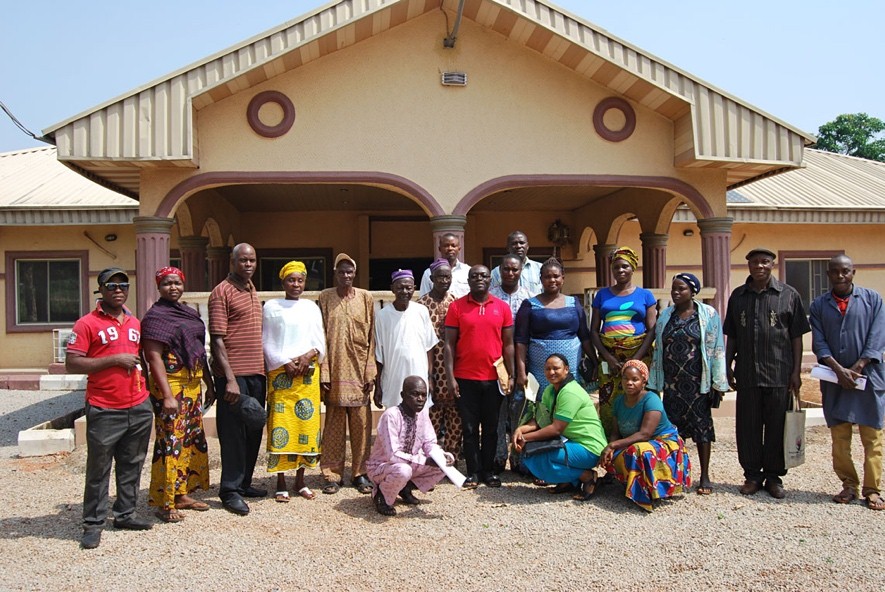
Since the inaugural meeting of EDEMCS (Ewu Development and Educational Multipurpose Co-operative Society) took place more than a year has passed. The organization has mastered many stages ranging from the official registration with Edo State, the cultivation of interest and trust in the village up to the engagement of the community.
Fortunately, the King of Ewu, Father Anselm Adodo (OSB), the St. Benedict Monastery and Paxherbals enjoy a great amount of respect in the community, making it easier to align the interests of the local individuals. Hence, EDEMCS was able to tackle its first project: empowering local women through micro financing.
It was agreed that women should be the focus of the first round of financing for various reasons: First and foremost, women in Ewu are more reliable when it comes to paying back loans and secondly it is important to nurture the process of emancipation in the community in order to start the transformation. In that sense, the stage was ready for the first act of financing.
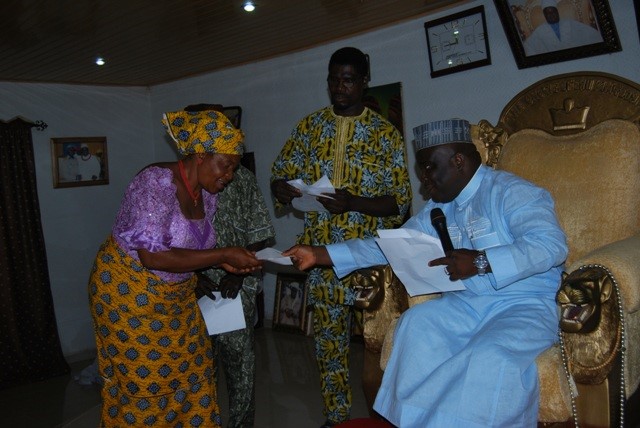
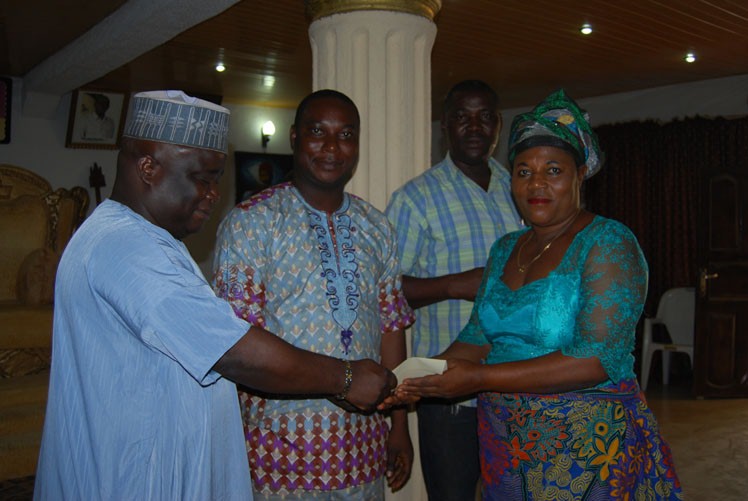 On January, the 23rd 2016 on a hot dry-season day the local farmers, those that were selected by the EDEMCS committee, gathered at the palace of the King of Ewu. The purpose of this meeting was one of a positive nature: the first check in the young history of EDEMCS was presented to the local women on that day.
The money was given out to 7 farmers, each representing one of the seven communities which compose the Ewu-Kingdom and each check was worth N50,000. An agreement was reached, that there should be two payments over the course of 12 months with an interest rate of 10%, culminating in N55,000. The 10% interest rate is unheard of in Nigeria since normal interest rates for micro financing banks start from 15% and go up to 25%.
The local farmers are accompanied by EDEMCS throughout the whole process of cultivation. They are tutored in traditional farming techniques to ensure the survival and spread of indigenous knowledge. Frequent consultations by EDEMCS ensure that this first batch of financing is a successful one and only one of many more to come.
While the women are cultivating their first crops with the help of EDEMCS, the next round of financing is being negotiated with Sterling Bank, so that many other farmers can benefit in the foreseeable future.
written by: Amadeus Stickl