Category: VIEWPOINT

  • COMMUNITALISM IN ACTION

    COMMUNITALISM IN ACTION

    [embedyt] https://www.youtube.com/watch?v=dc8Q2WZ_m0g[/embedyt]

    An interpretation of the theory of Communitalism by students of International Development at the University of St Galen, Geneva, Switzerland, in association with students of integral transformation at Paxherbals.

  • The Pioneer Students Transformation Studies in Africa [Video]

    The Pioneer Students Transformation Studies in Africa [Video]


    [fullscreenvideo videourl=”https://youtu.be/tGFp-4BmBJc”]

    Watch video of the pioneer students of Transformation Studies in Africa (TSA) from the Institute of African Studies, University of Ibadan, Nigeria. This is the first fruit of a project with a very humble beginning

  • The Idea Of The Communiversity

    The Idea Of The Communiversity

    ABOUT THE BOOK

    Across the world, we are facing a crisis in education at all levels: for some communities, schooling remains inaccessible, and for others, educational institutions have become elite qualification factories. For most, the cost of higher education is rising.  Underlying these profound challenges are fundamental questions about the nature of universities and higher education in general.

    What kind of knowledge do we need to survive in the present century and next? Do the current modes of knowledge creation and application address the challenges of the 21st century? How do we bridge the dichotomy between being and knowing, research and innovation, theory and practice? Perhaps for the first time, a group of scholars—a veteran Afro-European political philosopher, a Catholic cleric and social scientist, and an Anglican priest/political economist—have taken a step further and asked: is it possible to re-imagine and re-invent the global university system?

    In The Idea of the Communiversity, they propose a new approach to the economic, social, technological, educational and moral transformation of society. This book takes an integral world’s approach to societal transformation, by pointing to ways in which we can reform our modes of knowledge creation. Through the fourfold model of community, pilgrimium, academy and co-laboratory, Lessem, Adodo and Bradley—all intellectual and grassroots activists—have re-conceptualised a university for every people and culture, centred on the need to think local and act global.  We have seen the eras of post-colonialism and decoloniality. This book ushers us into a new one—that of the Communiversity.

    ABOUT THE AUTHORS
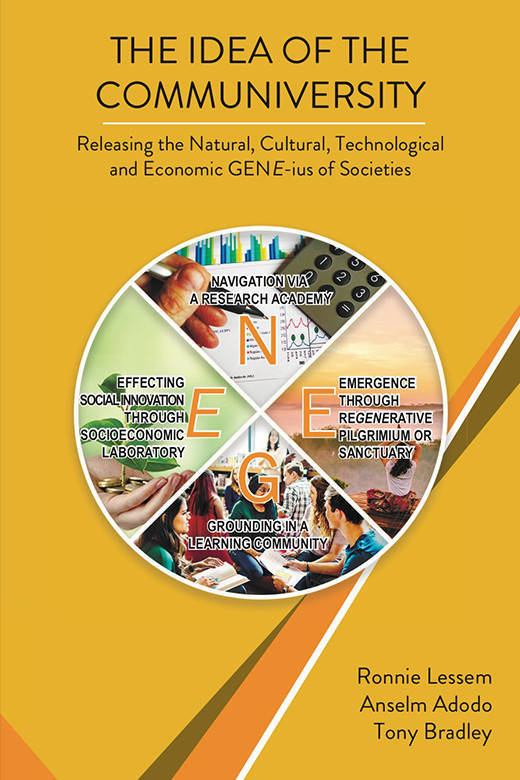
    The Idea of the Communiversity was born out of the communal, conscious raising and the conceptual and commercial experiences of three people: Samanyanga Ronnie Lessem, an Afro-European social philosopher, Anselm Adodo, a Nigerian-Benedictine priest, philosopher and social scientist, and Tony Bradley, a Celtic-Christian intellectual activist. Each of them, in association with their academic and commercial organisations and societies, spread altogether over 120 years, has sought to transcend the divide between industry and academe, the spiritual and the material, community and economy, one cultural world and another. Each of them has devoted a lifetime to bridging different worlds, most especially those of community and university, albeit also aligned with spirituality and with enterprise, spread across the south and the north, the east and the west

    PRAISE FOR THE BOOK FROM ACROSS THE DIFFERENT WORLDS

    FROM THE SOUTHERN WORLD

    ‘The ‘‘Communiversity” idea is timely. It challenges the dominance of the conventional University. What is even more exciting and appropriate is the fact that this birth is being presided over by Africans, alongside significant others around the world, representing the authentic natural grounding critical for knowledge creation and societal renewal altogether. The Comuniversity is clearly an answer to a distraught world in which the conventional University has failed to provide solutions. For me,  “University” speaks of individualism and selfishness leading to destructive detachment from reality, whereas “Communiversity” speaks of community and teamwork leading to inclusive, transformative development. The time for the Communiversity has indeed arrived!’

    Douglas Mbowane, CEO, Econet Wireless, Harare, Zimbabwe.

    ——————————————————————————————————————–

     ‘The Idea of the Communiversity’ is at the frontier of the decolonisation project in Africa and the global South.  It is a long-awaited book that makes it clear that it is possible to decolonise knowledge production by reconnecting the sites where knowledge is produced (universities) and the sites where it is applied or practiced (community). Written by eminent African-oriented scholars, the book provides a clear answer to people who are seeking answers to the question: What does the decolonisation of knowledge and the curriculum entail?  This is a must read for any person (student, researcher, activist, teacher, professional, politician), interested in learning about the practical implications of transforming the African university and beyond. The book carries a revolutionary seed for changing the way we produce and validate knowledge.’

    Horman Chitonge, Associate Professor at the Centre for African Studies, University of Cape Town, South Africa, and author of Economic Growth and Development in Africa: Understanding Trends and Prospects.

    —————————————————————————————————————-

    ‘The very concept of ‘communiversity’ demonstrates that there are thinkers among us who are rising to the current global systemic and epistemic crisis, characterised not only by uncertainties of knowledge but by the very idea of a university being questioned and universities turning into the key site of struggles. ‘The Idea of the  Communiversity’ is a welcome contribution, which transcends seeking to know the world of knowledge and its politics but, courageously and innovatively, offers a way in which to change it. I have nothing but praise for this important book.’

    Professor Sabelo J. Ndlovu-Gatsheni, author of Epistemic Freedom in Africa: Deprovincialization and Decolonization. Head of Change Unit, University of South Africa, Pretoria.

    —————————————————————————————————————

     ‘The sheer audacity and intellectual confidence to think outside the box and initiate an alternative approach to education and development, as demonstrated in this book, is commendable. Kudos to our own Fr Adodo and his counterparts across the world. As a responsible government, we cannot afford not to listen to these voices of reason.’

    Godwin Obaseki

    Executive Governor, Edo State, Nigeria.   

    ————————————————————————————————————–

    ‘This book is timely. It comes at a time when scholars are in search of the Model University that would be more relevant to the social and economic needs of the 21st century.  The need to forge a union between industry and academe, community and economy and revamp the spiritual and moral foundation of society cannot be more pressing than now.  The world needs a university model that can reconcile it with nature, community and the environment. I applaud the vision behind the book.’

    Professor Ben. E. Aigbokhan, Vice-Chancellor, Samuel Adegboyega University, Ogwa, Nigeria.

    ———————————————————————————————————————-

    ‘This book is an invitation to reconnect with the healing power of nature: a spiritual, psychological, cultural and technological Renaissance. Theology, Medicine, Law, Technology and the  Liberal Arts constitute important issues in the communiversity and related institutions-an era of the social laboratory. The authors clearly expended great energy, enthusiasm, efforts and patience to produce this work.’

    Professor Abiodun Falodun, Rector, Edo State Polytechnic, Nigeria.

    ——————————————————————————————————————-

    ‘A masterpiece. Daring to think differently. A profound work of impeccable scholarship.’

    Professor Oluwatoyin Ogundipe, Vice-Chancellor, University of Lagos, Nigeria.

    ——————————————————————————————————————

    FROM THE EASTERN WORLD

    The Idea of the Communiversity’ is a compelling and enlightening read. It is a genuine effort to reap the fruit of integral knowledge. By reinventing terms for this knowledge, the authors are able to coin an authentic definition of learning, where the roots of meaning evolve from communities. Communiversities are live organisms that stem and grow in their unique soils of origin.’

    Senator Haifa Hajjar Najjar, Jordanian Senate House: The Upper House of Jordanian Parliament.  ———————————————————————————————————————

    ‘As ‘humanity’ seems to be less and less of a commodity in our workplaces and societies, it is prime time to return human consciousness and a sense of belonging in the world. The Idea of the Communiversity offers a new path – an integral approach to learning and being that is rooted in one’s self and community, while embracing global knowledge and enterprise to make a genuine difference in the world we live in.’

    Dr Hassib Sahyoun, Founder and CEO, Medlabs Jordan.

    ——————————————————————————————————————-

    ‘An intellectually stimulating book. It challenges the conventional Eurocentric narrative and puts forth an alternative development approach, nesting together often undermined forces of the community, local knowledge and spirituality – combined, they present a new paradigm of inclusive development. A unique effort – like a breath of fresh air.’

    Dr Amjad Saqib, the Founder of Integral Finance (Akhuwat), Pakistan.

    FROM THE NORTHERN WORLD

    ‘A truly inspiring text that proposes a visionary and unique approach to community, culture and academia in changing socio-economic times. The idea of communiversities challenges historic practice and embraces our current local culture with a new mindset and in a new way.’

    David E. Jenkins, CEO – The Old Courts Arts & Heritage Trust, Wigan, UK.  

    ————————————————————————————————————————

    ‘Ronnie Lessem is always worth listening to. He challenges the normal and inspires the extraordinary. This book could change your life and our world.’

    Dame Jayne-Anne Gadhia, ex CEO, Virgin Money, Founder of the Gadhia Group, UK.

    ———————————————————————————————————————              

    ‘The authors argue the urgency of re-situating knowledge/learning communities in historical time and diversity of culture and place.  They recall the complex genealogy of Western knowledge institutions (library, monastery and academy, through medieval Republic of Letters, to modern university and laboratory): they insist on the interplay of oral and written forms of knowledge; and on the links between learning, reconciliation, healing and human community.  And then, politely, on the challenge to “subvert the epistemological scaffolding” that underpins current Western hegemony (and its discontents) — developing through world examples the proposition that “in the present moment, it is the global south that affords privileged insight into the workings of the world at large”.  They show that the time has arrived for the resurgence of an intellectual ‘appropriate technology’.’

    Professor Martin O’Connor, Professor of Economics, Université Paris-Saclay, France.

    —————————————————————————————————————–

    ‘From social innovators in local communities to top leaders of our societies, from rural communities to academia, we urgently need the change of perspective elaborated in this book. In order to release the GENE-ius of Self-Organisation-Community-Society – including Economy – the paradigm shift that these authors advocate includes overcoming the over-emphasis of “Western” and “Northern” perspectives in knowledge creation and sharing. Learning rooted in nature and community, as well as culture and spirituality, are indispensable elements of the  “communiversity”. The communiversity idea will effectively promote the knowledge-and-institutional transformation needed to address the burning issues of our time.’

     Dr Darja Piciga, founder of the Citizens’ Initiative for Integral Green Slovenia.                                                  

    ——————————————————————————————————————-

    FROM THE WESTERN WORLD

     ‘In this path-breaking book, Lessem, Adodo and Bradley call for a novel re-conception of the modern techno-centric university. In place of the hierarchical and individualistic university, these scholars propose an institution that is spiritual in purpose, that is communitarian in orientation, and that seeks the transformation of the individual and her society. They call this reimagining of the university a “communiversity” and view it as a combination of a community of scholars, engaged in a transformative journey (pilgrimium), that is both an inclusive academy and a functional laboratory. This book is a call to action for educators and activists to create an institution that can work to change concrete societal problems.’

    Professor Kenneth B. Nunn, Professor of Law, University of Florida, USA.        

    —————————————————————————————————————–

    ‘In ‘The Idea of the Communiversity’, Lessem, Adodo and Bradley guide us on an epic journey toward reimagining knowledge creation and its application for the purpose of bringing integral transformation to a world in desperate need. Drawing on the historic roots of knowledge creation and transmission, the authors propose a newly integral “Communiversity” as an alternative to the now moribund traditional university construct, where one’s size is supposed to fit all learners. In a world rife with endemic challenges without solutions, the Communiversity’s core elements of Community, Pilgrimium, Academy, and Laboratory offer new hope for the challenges our world faces, by excavating long neglected indigenous knowledge sources that can lead to innovative solutions both local and global. The time has come for the Communiversity!’

    Dr Sam Rima teaches at Bethel University, Minnesota, USA. He is author of Spiritual Capital: A Moral Core for Social and Economic Justice.

    You buy this book online from Paxyou website by clicking on the buy now button below

    [imic_button colour=”btn-default” type=”enabled” link=”https://www.paxyou.com/product/the-idea-of-communiversity-releasing-the-natural-cultural-technological-and-economic-gene-ius-of-societies/” target=”_blank” extraclass=”” size=””]Buy This Book Now[/imic_button]
  • A Man Like You

    A Man Like You

    A Poem by Fr. Anselm Adodo


    I knocked at your door
    The door of your heart.
    Can you not hear me?
    Open for me, my brother!
    I knocked at the dawn of my sleep
    I knocked at the wake of my day
    I knocked with the veins of my heart
    I knocked at the fall of my power
    Can you not hear me?
    Open for me, my sister!
    You asked me if I am a Christian
    Or a Muslim, or a pagan.
    You want to know if I am of your tribe
    Or speak the tongue of your father
    Or dream the dream of your mother
    Before you would open for me.
    What does it matter if I am white or black
    Green or yellow
    Short or tall?
    You want to know who I am?
    I am bone of your bone
    And flesh of your flesh
    I am a Man like you!
    Open for me, my brother!

  • Fr. Anselm Adodo Delivers Faculty Lecture at University of Ibadan

    Fr. Anselm Adodo Delivers Faculty Lecture at University of Ibadan

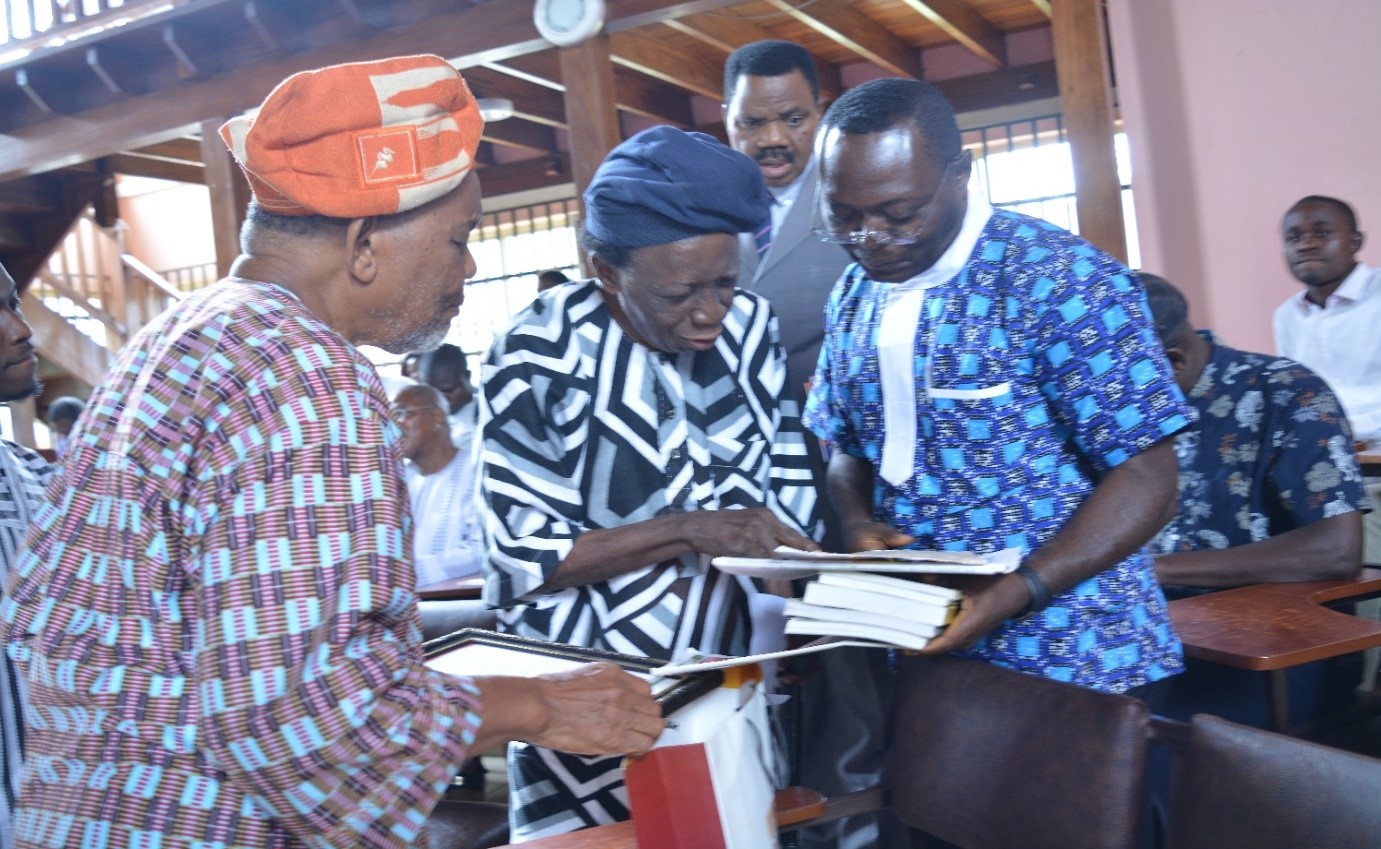
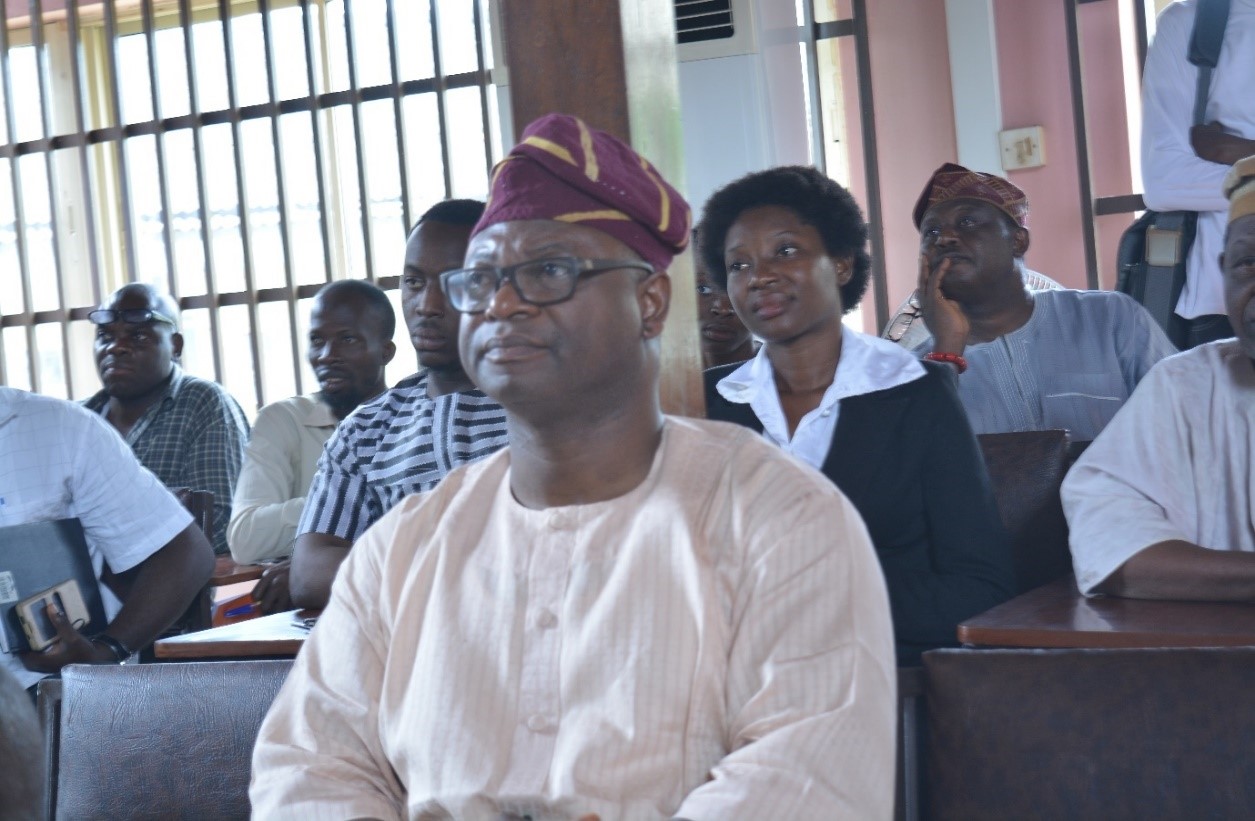
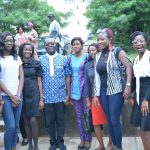
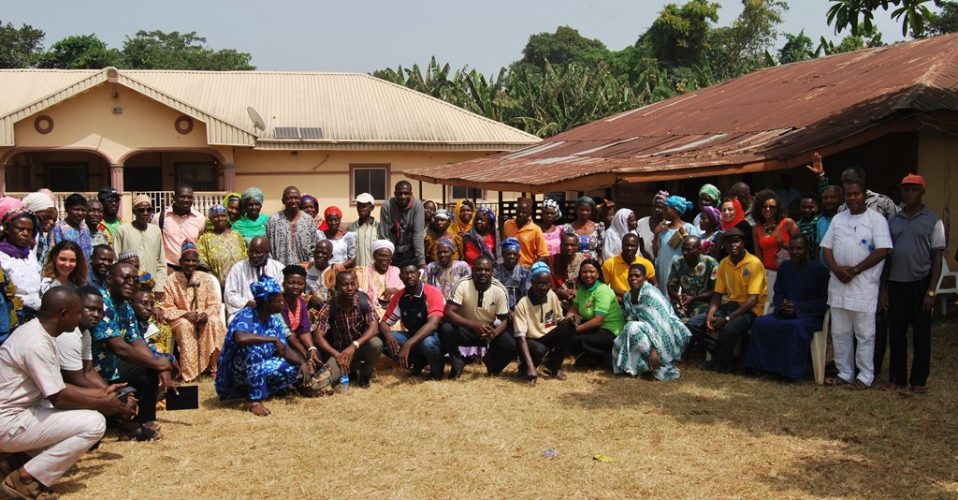
    On July 25, 2018, Fr. Adodo delivered the faculty lecture at the University of Ibadan.  The seminar lecture series is sponsored by the council for the Development of Social Science Research (CODESRIA). The seminar, which held at Lady Bank Anthony Hall, at the Institute of African Studies, University of Ibadan, was attended by an unprecedented crowd comprising students, university professors, Researchers, government officials, Politicians, and celebrities. Chairman of the occasion, Prof. David Okpako, retired prof of Pharmacology at the University of Ibadan, set the scene by emphasising the importance of studying Africa with African eyes; that is, Africans tackling issues of culture, race, economics, and development from their own perspective and based on their own worldview.  The in-coming Director of the institute, Dr. Jimoh Olaoluwa, expressed his delight at the high turn-out of participants and the interest which Transformation Studies have generated in the University.

    In the lecture, which was titled: ‘Transformation Studies in Africa. Researching Africa with African Eyes’, Fr. Adodo went straight to the point. According to him: ‘The first part of African liberation story was the ‘successful’ struggle for political independence from the colonial powers. The second part was the era of independence when power ‘successfully’ shifted to the African Nationalists. This paper argues that the third part towards African emancipation is for the common people of Africa to free themselves from their leaders. African leaders, from Zimbabwe to Uganda, Cameroon, Liberia, Burundi, Togo, Nigeria, Ivory Coast, Senegal to the Benin Republic, Kenya and the Democratic Republic of Congo, to mention a few, have obviously betrayed the trust of their people They have succeeded in amassing state wealth into their own private pockets and lacked the will, skill, and sincerity to govern and transform their countries. It is therefore evident that Africans should not expect much from their leaders and must now learn to free themselves from the greed of their leaders. Civil wars or violent protests, as we saw in the so-called Tunisian and Egyptian uprising, cannot make this happen. This paper posits that a more systematic approach, that evolves from the ground up, naturally and culturally, technologically and economically, within a functional polity, is the most efficient and sustainable way to transform Africa. The theory and practice of such an approach is the basis of the new curriculum on Transformation studies in Africa (TSA).’ 

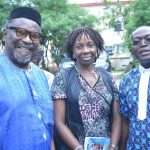
    Fr. Adodo, Dr. Omolulo Olunloyo, Former Governor of Oyo State, and Prof. Joseph Okogun, now a visiting Professor
    Fr. Adodo, Dr. Omolulo Olunloyo, Former Governor of Oyo State, and Prof. Joseph Okogun, now a visiting Professor in the USA,

    Quoting an African Proverb which says that, ‘Until the Lion learns to write, every story will glorify the hunter’ and also Chinua Achebe’s words: ‘If you don’t like someone’s story, write your own’, Fr. Adodo passionately argues that Africans need to stop blaming the foreign powers for their woes, but rather, face their problems with courage and determination, and learn to tell their own story in their own words, metaphor, and Language. According to him: ‘Many African nations are yet to upgrade, renew and evolve their knowledge bases. They find a lazy and easy excuse in referring to times past, the ‘good old days,’ to ancient ways of life that are not compatible with modern realities. Others blame Colonialism, Capitalism, Civilisation or Modernity. It is true that we were once enslaved; it is true that some capitalist foreigners invaded our land and ruled over us and exploited our natural resources for selfish gains. But were we the only race that was so colonised? And how long shall we continue to blame other people for our woes? Is it not time we courageously face our problems and see them as challenges for growth? When a man in faraway Spain says something derogatory about a black man, we all rightly stand up in protest against his racist tendencies. But why wouldn’t we also wage war against the tribalist in each of us, among our own kin?’

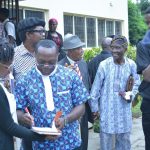
    Oyewole Oyewumi, Oyo state commissioner for Agriculture, Natural resources and Rural Development
    Oyewole Oyewumi, Oyo state commissioner for Agriculture, Natural resources and Rural Development

    Fr. Adodo re-emphasised the fact that for Africans, economic and social freedom are not enough.  The most important freedom, according to him, is cognitive freedom. In his own word: ‘People cannot be liberated by consciousness and knowledge other than their own. It is therefore essential that Africans develop their own indigenous consciousness-raising and knowledge generation, and this requires the social power to assert this. It is not enough to engage in education, the structure of the knowledge itself has to be examined and questioned. It is not enough to study scientific truths, how science arrived at such ‘truths’ has to be challenged. Science does not exist independently of its cultural context, despite its pretence to undiluted objectivity. While education can bring liberation, it can also be a means of keeping people in bondage.

    In conclusion, Fr. Adodo said that: ‘We need the cognitive freedom to help us resist the danger of being ‘storyotyped’ (origin of the word stereotype) again, as our ancestors were. This is what Transformation studies in Africa is about: researching Africa with African eyes.

    More photos from the event

  • Reforming Education In NIGERIA: Thinking Outside the Box

    Reforming Education In NIGERIA: Thinking Outside the Box

    Have you heard our young men discussing football recently? They know all the latest news on the English Premier League. They can tell you when Manchester United is playing Chelsea, and can even predict who will win and by how many goals. Thanks to cable, internet and satellite TV, our young people also know how many soldiers are killed in war zones daily, how many suicide bombings take place and how many people are kidnapped by militants. They know which countries have the most relaxed immigration rules. But ask them about the health benefits of banana, or how bush burning affects soil productivity, or what a balanced diet is, and you will be surprised at their level of ignorance.

    Young Nigerians are readily acquiring information about other lands, while rapidly losing knowledge of their own land, their environment, their culture and their people. This is a problem because no nation can truly develop until it has a deposit of local knowledge which it preserves and nurtures. True and lasting development is not imported from other countries – it is home-grown. The art of development is the ability to convert and exploit local knowledge to create relevant, sustainable and affordable technology. The best solutions to a  nation’s problems are those which come from within. But because this isn’t recognised, indigenous knowledge is not properly valued – and is being lost at an alarming rate.

    In many indigenous societies, when a knowledge-bearer dies, his knowledge dies with him. With every old person who dies in our villages, the equivalent of a library is lost. Today, we speak of protecting the environment and our rare species of plants and animals. But equally important is the need for national and international efforts to protect and preserve indigenous knowledge.

    At the national level, our country’s education system has a vital role to play in ensuring that indigenous knowledge is shared, preserved and used for our country’s development. But today, education in Nigeria is too preoccupied with other interests and goals. Most students in Nigeria are brainwashed to think that the reason they go to school is simply to acquire paper certificates in order to get a career. Our society prides acquisition of degrees over holistic and integral personal development. What a misconception! It is no wonder that our education system in Nigeria is so examination-oriented. Even infants in kindergarten are expected to sit and ‘pass’ exams.

    The goal of education should not be just mastery of subject matter, but mastery of one’s person. The goal of education should not be to stuff facts, techniques, methods and information into students’ minds, but rather to teach them how to use ideas and knowledge to develop their own personhood. Yet today, rather than seeing education as a means of personal development, most students see it as a step towards a career, as something that will launch them into a so-called ‘successful’ life. Proper education should help students to find a decent calling or vocation, not just a career. A career is a job, a way to earn one’s daily bread. A
    calling is about life, personhood, values, and one’s vocation and gift to the world. It comes out of one’s inner convictions. A career can always be found in a calling, but it rarely happens the other way around.

    For centuries, human beings lived under the illusion that with enough knowledge and technology, we could manage and control the Earth. As new factories and industries produced more computers, electronics and machines, we thought we had succeeded in mastering our planet. We thought that a rapid increase in data, words, paper and technical details was equivalent to an increase in knowledge and wisdom. The truth,  however, is that as we grew in technical knowledge – in ‘know-how’ – we lost other kinds of knowledge:
    intelligence, which is characterised by an ability to foresee the consequences of one’s actions; wisdom; and ‘know-why’. Our students graduate from universities with a distorted view of reality, of nature and of the cosmos. Some of these students score highly in their examinations and are then regarded as ‘experts’. They are seen as brilliant and clever. They have the technical know-how, but they cannot ask the deeper questions of life. University education provides students with answers – without them even knowing what the questions are.

    It is worth noting that the people whose work and ideas have led to the destruction of the ecosystem, disturbance of climate stability and depreciation of biological diversity are not ignorant people: indeed, the vast majority of these people have letters after their names. For humanity to survive, we must give up the misleading conception that western culture represents the pinnacle of human achievement. Modern capitalist culture does not nourish that which is best and noblest in the human person. It does not cultivate vision, imagination, a sense of wonder and spiritual sensitivity. It encourages pride instead of humility, violence instead of gentleness, greed instead of generosity, individualism instead of communality, selfishness instead of selflessness, monoculture instead of cultural diversity.

    Is it not strange that there was such a huge uproar when the cut-off for admission to Nigerian universities was recently lowered by the regulatory authority? The general consensus seems to be that passing exams is the only method of ascertaining creativity and intelligence. Such a reaction itself is a reflection of our own narrow understanding of education and excellence.

    University education has three aspects: form, process and content. Form – which is the focus of almost all discussions about university education in Nigeria – refers to a university’s physical structures,  bureaucratic systems, salary and finance systems and organogram.

    Process refers to the relationships between vice chancellors and lecturers, between students and lecturers, and between the university and the host community as well as the society at large. It is a sad fact that many Nigerian students pay their way through universities via kickbacks and bribes, sexual molestation of female students by lecturers is alarmingly common, and there is a clique within the university system that silences those who complain openly. How do you reform education when the process is so dirty?

    The third aspect is content, which refers to the curriculum and the literature used in teaching. A look at the content of Nigeria’s university curricula indicates that colonialism is still very much alive and active, and true independence is still far off.  University education is the most colonised aspect of African life. Each year we churn out graduates who lack knowledge of their history, have no appreciation for their tradition, and who see reality through the prism of western reality. In my view, a decolonisation of our university curricula and literature is the most urgent reform of education that is needed in Nigeria and Africa. I look forward to the days when strikes by university lecturers will not just be about money and finance (form), but also about morality (process) and the quality of the curricula (content).

    It is not enough simply to engage in education. The structure of the education itself has to be examined and challenged. It is not enough to study scientific truths; how science arrived at such ‘truths’ has to be questioned. Science does not exist independently of its cultural context, despite its pretence to undiluted objectivity. While education can bring liberation, it can also be a means of keeping people in bondage.

    And lest we forget, education is no guarantee of decency, prudence or wisdom. Learning in itself will not make us better people. The worth of education must be measured against the standards of decency and human survival. It is, therefore, wrong to think that education in itself will save humanity. Our survival in the next century depends on education, but not education as we have conceived it for over 60 years. We need a new kind of education.

    Anselm Adodo is a Catholic priest and Director of Ofure (Pax) Centre for Integral Research
    and Development and of Paxherbals.